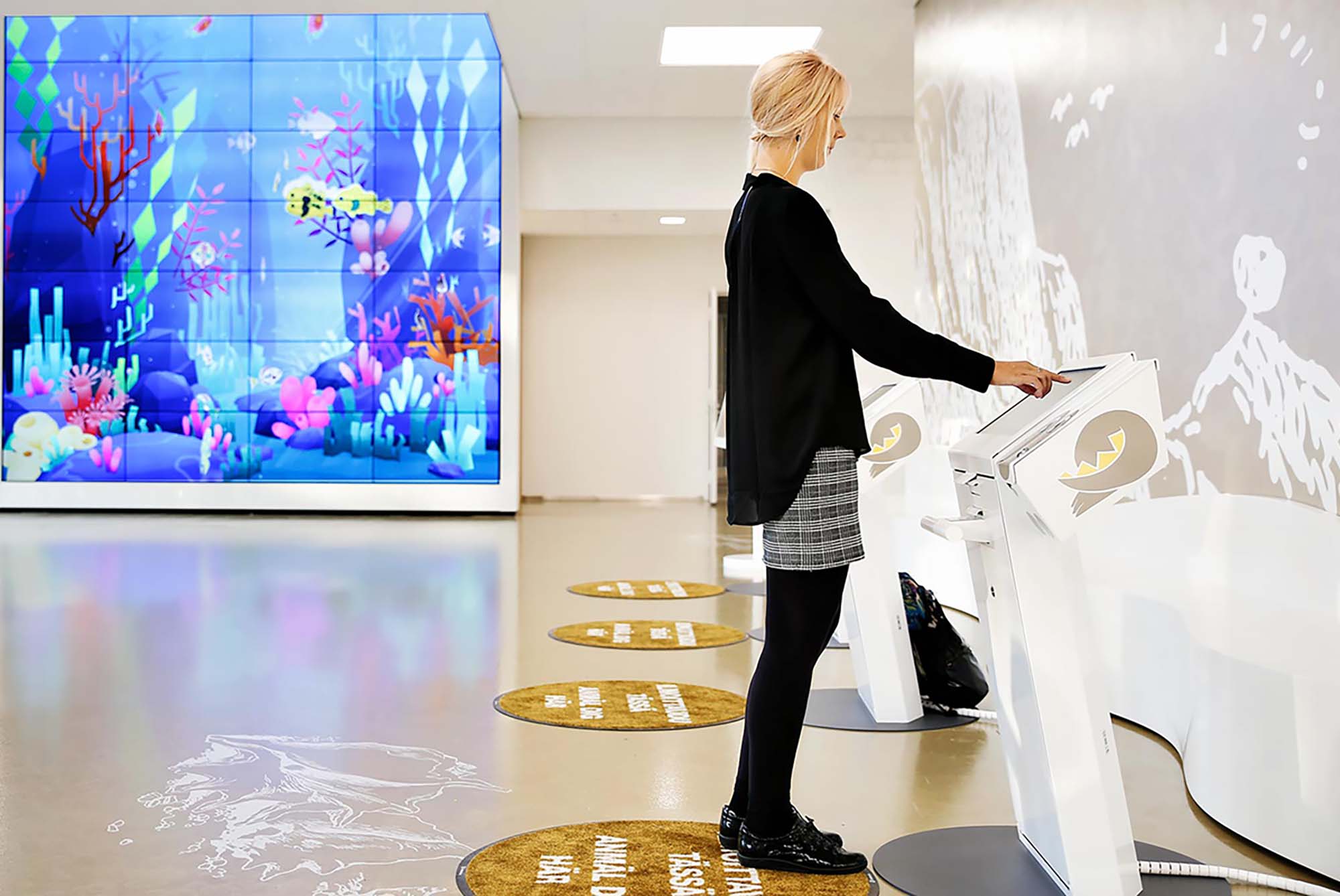

How can we make healthcare waiting areas safer and more pleasant? Traditional, crowded waiting rooms pose a challenge for both infection control and the overall patient experience. In this blog, we explore how mobile solutions and remote waiting enable safer visits and more efficient patient flow management by making waiting independent of a specific physical location.
One of the recurring challenges in healthcare has been infection control and the smooth organization of patient flows. When large numbers of people gather in the same space, the risk of spreading seasonal influenza and other infectious diseases increases. Waiting areas should not be places where health risks grow, but safe transitions between different stages of care. A single patient can expose many others to an illness, even though a health center should be a place where people come to get better – not the other way around. How could we solve this? Logically, there are two alternative ways to avoid patients exposing one another: 1) patients do not come to the health center or hospital at all, or 2) patients do not meet each other at the health center or in the hospital.
How could we resolve this? Logically, there are two alternative ways to avoid patient-to-patient exposure:
1) Patients don’t go to a health center or hospital at all.
2) Patients don’t meet each other in a health center or hospital.
Remote consultations and home visits as complementary services
The first solution can be further divided into two different alternatives: the patient is encountered physically or the patient is encountered remotely. Home visits are a great complement to our current way of organizing healthcare and are quite common, especially on the social services side. Home visits are also popular in healthcare, but quantitatively they don’t come close to home visits done in different institutions. Home visits are an effective, yet expensive solution for treating many diseases, for example, because of transition periods. And what about remote receptions which are quite effective for both patients and healthcare organizations? A large proportion of outpatient visits can be handled remotely through text messages, audio, and video, and by the end of the pandemic, remote receptions will have become part of the mainstream. The biggest challenge for healthcare is to identify and decide which diseases and illnesses can be diagnosed and treated remotely – and which require physical interaction.
Patient flow management as a key to minimizing unnecessary contact
Another solution – reducing patient encounters in health centers and hospitals – requires effective patient flow management. The majority of healthcare facilities are designed so that patients sit in waiting rooms or corridors close to one another. From these areas, they are then called in one by one to the consultation or sampling rooms. From a production economics perspective, this is efficient, but this operating model does not take into account the minimization of patient‑to‑patient exposure. However, the problem can be solved with the help of technology.
Mobile solutions enable location-independent waiting
The remote call in that a patient receives on their mobile phone makes the wait independent of a particular location. Thus, patients can wait for their turn, for example, outside the health center or in a wider area than just in the vicinity of the treatment rooms. This reduces patient congestion and thus also reduces exposure to potential pathogens.
Modern patient flow management tools make remote waiting possible. There's no need for healthcare organizations to make major changes to their normal ways of working, but they can reduce patients' health risk and, at the same time, congestion in health services. In addition, space planning in healthcare facilities makes it easier to get rid of traditional waiting rooms and move to more creative and cost-effective solutions.
How are remote waiting, remote call ins, and other solutions mentioned above implemented in practice? Read more about our self-service and mobile solutions.